

Enterprise Accessibility Services
Enterprise accessibility rarely fails because of one broken page. It fails because dozens of products, teams, and regional entities each solve accessibility their own way, or not at all.
We run the program that keeps every product, team, and region aligned to the same standard, with the documentation to prove it.
Trusted by organizations building more accessible digital experiences.
















Why do enterprises need a dedicated accessibility partner?
At scale, accessibility stops being a testing problem and becomes a coordination problem. Different teams apply different interpretations, and isolated fixes never propagate beyond the product that made them.
A dedicated partner gives the organization one standard, one owner, and one record of progress across the whole portfolio.
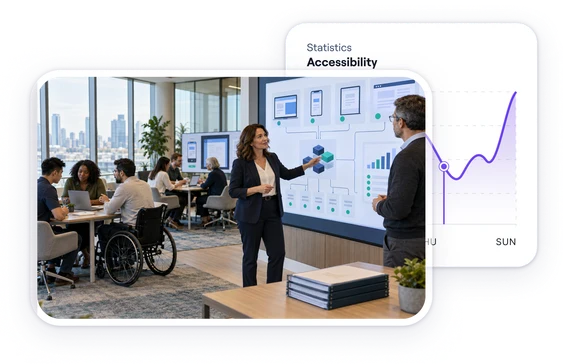
Organization-wide consistency
Every team measured against the same criteria.
Fixes that scale
Corrections made in shared components, not repeated product by product.
Procurement-ready evidence
VPATs, ACRs, and statements available before a customer asks.
Centralized ownership
Progress tracked across products instead of scattered across tickets.
What's Included?
Portfolio baseline assessment
Every in-scope product is tested with automated scanning and manual review to locate the worst gaps.
Manual and assistive technology testing
Screen reader, keyboard, and real user journeys are tested by hand across critical flows.
Design system remediation
Fixes are applied at the shared component level, so one correction reaches every product built on it.
Product-level remediation
Issues that live outside the design system are resolved directly in the affected product.
VPAT and ACR production
Conformance documentation is produced in the version your market and customers require.
Accessibility statements
Public statements are written to match what remediation actually changed, not what was planned.
Continuous monitoring
Regressions are caught after each release rather than at the next annual audit.
Governance and reporting
Ownership, escalation paths, and leadership reporting are defined and maintained.
Our enterprise accessibility services cover your entire product portfolio, from assessing gaps and fixing shared components to documenting conformance, assigning ownership, and monitoring accessibility after every release.
Which organizations is this built for?
Multi-brand SaaS and software platforms
Facing accessibility questionnaires from B2B customers during procurement, often as a contract condition.
Public-sector-adjacent and higher education
Often bound indirectly, where procurement rules or funding requirements reference Section 508 or WCAG.
Large e-commerce and marketplaces
High traffic meets high exposure, since a checkout that is not keyboard operable blocks the transaction outright.
Regulated industries
Finance, insurance, and healthcare carry higher scrutiny, so conformance evidence must survive outside review.
Multinational organizations
Needing one program that satisfies several jurisdictions at once instead of inconsistent regional efforts.
What these share is not an industry. It is one coordinated standard applied across many products, with documentation that holds up to whoever asks.
How does the program roll out?
Baseline assessment
Every in-scope product is tested, not fixed. Without a clear picture of the gaps, "fix everything" is the only prioritization available.
Prioritized remediation
The baseline decides what gets fixed first, usually the highest-traffic or highest-risk products, while lower-risk products wait deliberately.
Embedding into the workflow
Accessibility checks move into component libraries, design tokens, and CI pipelines so new work stops recreating old issues.
Documentation
VPATs, ACRs, and accessibility statements are produced from verified results and handed to procurement, legal, and compliance.
Governance and monitoring
The program shifts from a project to an ongoing cycle of monitor, remediate, validate, and review.
What exactly gets covered across the portfolio?
- Web Products
- Mobile Apps
- Design Systems
- Internal Tools and Dashboards
- Component Libraries
- Checkout and Payment Flows
- Account and Authentication
- Forms and Error Handling
- Keyboard Navigation
- Focus Management
- Third-Party Widgets
- Color Contrast
- Dynamic Content
- Data Tables
- PDFs and Documents
- Video and Captions
- CI Pipelines
- Screen Reader Announcements
- Regional Sites
Scope is set product by product, so regional entities and acquired brands are covered by the same baseline rather than left as exceptions.
Which Standards Do We Use in an Enterprise Accessibility Program?
WCAG 2.2 AA
The technical baseline nearly every other requirement references or aligns with. All testing is measured against it by default.
ADA
The ADA names no technical standard, but courts and settlements have repeatedly pointed to WCAG AA as the practical benchmark.
Section 508
Applies to US federal agencies and contractors, and references WCAG explicitly. Relevant to any enterprise selling into government.
EN 301 549 / EAA
EU technical standard covering software, hardware, and documentation. Transposition timelines vary by country — applicability confirmed per market.
Our reports document your conformance status at component level, with evidence your legal and compliance teams can act on.

Why WeAccess.ai for an Enterprise Accessibility Program?
| Criteria | Automated scanner at scale | Per-product audits | WeAccess.Ai enterprise program |
|---|---|---|---|
| Coverage | Structural rules only | Deep, but product by product | Portfolio-wide, automated plus manual |
| Where fixes land | Nowhere | In one product at a time | In the shared design system |
| Documentation | None | Report per product | VPAT, ACR, and statements per market |
| Consistency across teams | None | Varies by vendor and cycle | One standard, one owner |
| After the engagement | Same issues return | Same issues return next audit | Monitoring and governance cycle |
Running separate audits across twenty products produces twenty reports and no shared progress.
Why choose WeAccess.Ai for enterprise accessibility?
Testing that goes past automation
Automated scanning is combined with expert manual review, so technical failures and usability barriers both surface.
Remediation that scales
Issues are fixed at the design system and component level, which stops the same defect from reappearing across products.
Documentation tied to verified work
VPATs, ACRs, and statements reflect what was actually remediated, not what was planned.
Centralized coordination
One team coordinates across products, regions, and requirements, so leadership sees one picture instead of twenty.
Turkish, English, and German
We review content in all three languages and report in the one your organization works in.
FAQ
Still have questions? View our complete FAQ section.
Yes. The baseline assessment covers the whole portfolio, then remediation is sequenced by traffic and risk rather than run in parallel everywhere.
Yes. We produce the version your market requires and fill it with real test findings, including partial conformance with its justification.
Yes. Working inside your current components is the point, since a fix made at the source propagates to every screen built from it.
It depends on portfolio size and backlog depth. The baseline assessment is a defined project, while governance and monitoring continue after it.
Yes. Section 508, EN 301 549, and EAA requirements are covered on top of one WCAG testing baseline, with the paperwork each one expects.
Ownership is defined during the governance phase, covering design system issues, product-specific issues, and release approval.
Build digital experiences everyone can use.
See how WeAccess can help your organization manage accessibility across web, mobile, documents and media.