

VPAT / ACR Documentation
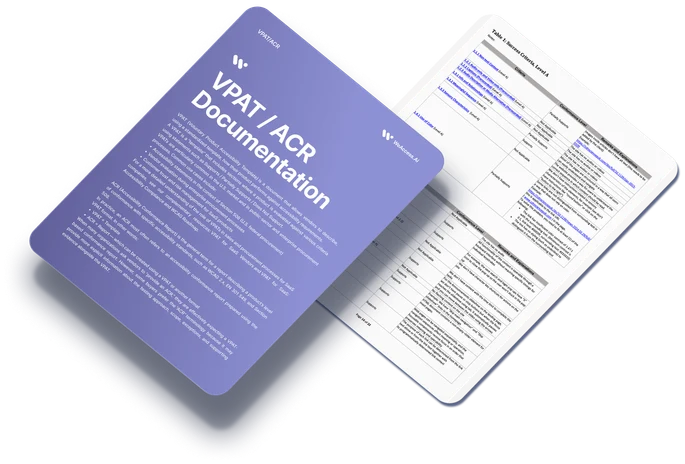
You need to document how far your product meets accessibility standards. We define the scope with you, run the testing, and produce the report in the right version — so you can hand procurement teams the information they expect, properly structured.
Trusted by organizations building more accessible digital experiences.
















What are VPAT and ACR?
The two documents complete each other. A VPAT is the template; an ACR is that template filled in with real test findings. What procurement actually asks for is the second one.
The VPAT is published by ITI and comes in four editions. Your target market decides which edition is the right one.

The right edition — WCAG, Section 508, EN 301 549 or INT.
Real test findings — Automated scanning and manual testing together.
Criterion-level explanation — A conformance level and rationale for every success criterion.
A document that stays current — The ACR is tracked across release changes.
What's Included?
Scope analysis
Which product, which version, and which screens will be assessed is settled up front.
Automated scanning
Criteria that can be checked at code level are scanned with automated tools across the whole scope.
Manual accessibility testing
Behaviour automated tools cannot measure is checked by hand by expert testers.
ACR report
A conformance report filled in with test findings, conformance levels, and explanations is delivered.
Screen reader and keyboard testing
The product is validated using real assistive technology.
Criterion-level documentation
A conformance level, an explanation, and a rationale for partial support are written for every success criterion.
VPAT document
Prepared in the right edition for your product, in the format procurement teams expect.
Tender file support
The accessibility information requested in corporate and public tenders is presented in a structured form.
We start by defining which product and screens are in scope. Automated scanning is backed by screen reader and keyboard testing, and the findings are documented criterion by criterion. We then produce the right VPAT edition, the completed ACR, and the accessibility information tender processes require.
Which edition do you need?

VPAT 2.5 WCAG
Reports conformance with WCAG 2.1 or 2.2 only. Usually enough for private-sector customers.
VPAT 2.5 508
If you sell to US federal agencies, the Section 508 edition is the one they ask for.
VPAT 2.5 EU
The EN 301 549 edition for the European market. Buyers may request it for products in scope of the European Accessibility Act.
VPAT 2.5 INT
Combines all three standards in one document. The most practical option for organizations selling into several markets.
Choose the VPAT version that matches your target market and procurement requirements, whether you need to report against WCAG, U.S. Section 508, European standards, or multiple standards in one ACR.
How does the process work?
Defining the scope
Which product, which version and which screens will be assessed is settled together. The target standard is chosen at this stage.
Assessment
Automated scanning and manual testing run together. Screen reader, keyboard and assistive technology testing is done by hand.
Documentation
A conformance level and explanation is written for every success criterion. Where support is partial, the rationale and the current workaround are stated.
Delivery and support
The document is delivered, and we stay with you for the questions procurement teams come back with.
Updates
The document is updated as your product changes, and tracked across releases so the ACR stays valid.
What exactly gets assessed in the documentation?
- Images (Alt Text)
- Forms
- Links
- Heading Structure
- Focus Indicator
- Keyboard Navigation
- Focus Order
- Color Contrast
- Modals
- Tables
- PDFs and Documents
- Buttons
- Dynamic Content
- Error Messages
- Menus
- Search
- Authentication
- ARIA
- Media and Captions
- Target Size
On the screens in scope, the elements a real visitor has to reach, read or complete are assessed — not only the ones an automated tool can see.
Standards & regulations we report against
WCAG 2.2 AA
The global technical reference many accessibility laws are built on. Some regulations refer to WCAG 2.1.

Section 508
Applies to the information and communication technology US federal agencies buy and use. Vendors selling to these agencies are usually asked for an ACR.

EAA
In force since June 2025 across areas such as e-commerce, banking and transport.

EN 301 549
The European reference standard; it adds software, hardware and documentation on top of WCAG.

Circular No. 2025/10
It does not mandate the VPAT format directly, but it does expect your accessibility status to be documented.
Our reports document your conformance status at component level. The findings are structured for review by your legal and compliance teams.


Why should you prepare your VPAT with WeAccess.ai?
| Criteria | Empty VPAT template | Automated scan report only | WeAccess.ai |
|---|---|---|---|
| Criterion coverage | Left to your interpretation | Structural rules only | YesEvery criterion in the selected standard is assessed individually |
| Manual and AT testing | None | None | YesScreen reader and keyboard testing included |
| Partial support rationale | Left blank | Cannot be produced | YesWritten with rationale and current workaround |
| Fit for procurement | High format risk | Not the document asked for | YesAn ACR in the expected format |
| Staying current | One-off | One-off | YesTracked across release changes |
A VPAT filled in incorrectly slows procurement down instead of speeding it up — it comes back, and it costs you trust.
Why choose our VPAT and ACR team?
Findings come with the fix
Every non-conformance is reported together with a recommended fix.
Real assistive technology testing
Testing is done with screen readers and keyboard-only use, not limited to a simulator.
A team fluent in procurement
We prepare the document for tender and supply processes, not only for your technical team.
Turkish, English and German
We review content in all three languages and deliver the report in the one you work in.
Support after delivery
The work is not finished when your customer comes back with questions — we are there for the answers.
FAQ
Still have questions? View our complete FAQ section.
A VPAT is the empty template; an ACR is that template filled in with test results. When a customer says "send us your VPAT", what they actually mean is the ACR.
There is no official expiry date; it loses validity as the product changes. In practice most organizations refresh it yearly, and immediately after a major release.
Yes — the point of an ACR is to document the current state honestly. Partial support and non-conformance are written with their rationale; hiding gaps is what makes the document worthless.
The circular does not mandate the VPAT format directly; it expects your accessibility status to be documented. A VPAT/ACR is the practical way to present that in an internationally recognised format.
Your target market decides: 508 for US public sector, EU for Europe, WCAG for private sector only, INT for several markets at once. We settle it together during the scoping conversation.
No. We test and document technical conformance; that document becomes the basis your legal team works from, while the legal assessment itself stays with your counsel.
Build digital experiences everyone can use.
See how WeAccess can help your organization manage accessibility across web, mobile, documents and media.