Digital Accessibility in the MENA Region: Laws, Standards, and Arabic Content

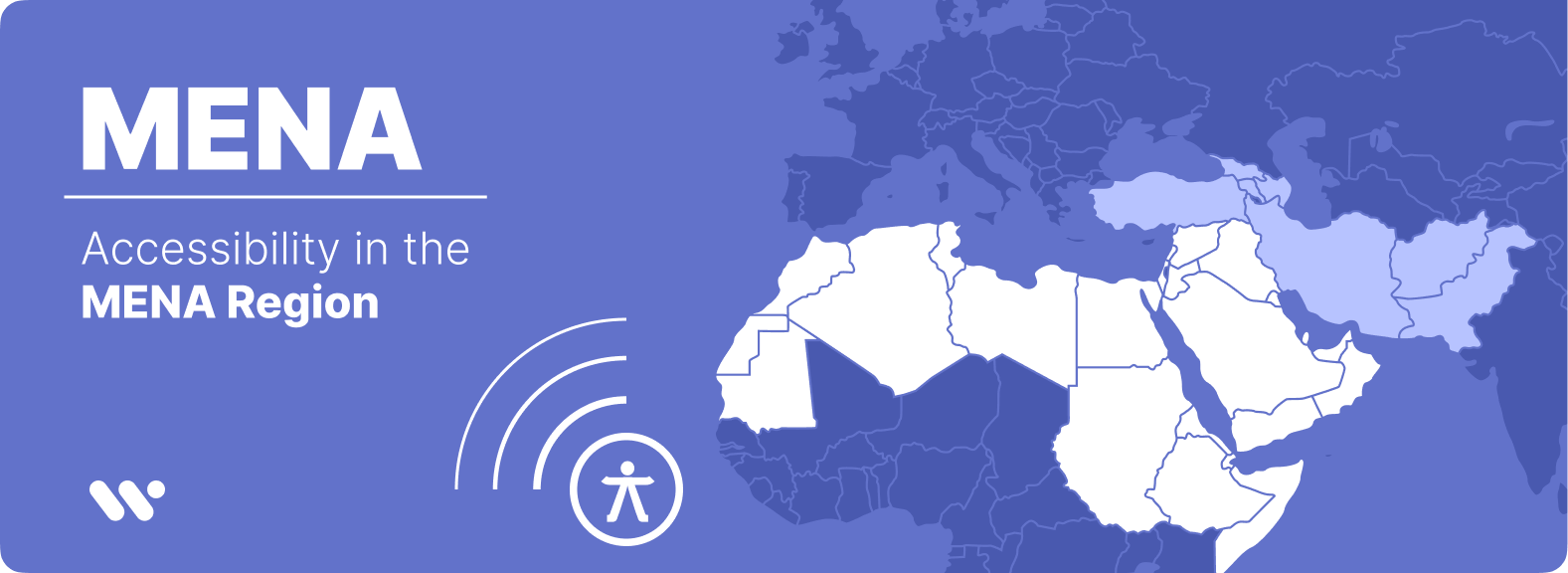
What Is Digital Accessibility in the MENA Region?
Digital accessibility means websites, apps, and digital services that people with disabilities can use, including people who rely on screen readers, captions, or keyboard navigation. In the Middle East and North Africa, it is shaped by national disability laws, government digital policies, and WCAG as the shared technical benchmark. Most countries in the region have ratified the UN Convention on the Rights of Persons with Disabilities, which treats access to information and communication technology as a right. How that right is enforced, however, varies widely from country to country.
Internet Access vs. Digital Accessibility: Why the Difference Matters
Internet access is about connectivity: whether people can get online at all. Digital accessibility is about usability: whether people with disabilities can use what they find once they are online. Several Gulf states have very high connectivity, yet a government portal can still be unusable for a blind user if its forms have no labels. Treating the two as the same problem leads organizations to invest in reach while leaving barriers inside the service untouched.
Accessibility Laws and Policies Across MENA
Approaches differ by country, but three Gulf states show how the region is moving from general rights to specific technical requirements:
- United Arab Emirates: Federal Law No. 29 of 2006 sets the rights of people of determination. The National Digital Accessibility Policy, adopted in 2024, requires federal government services to meet WCAG 2.1 AA. In Dubai, Law No. 3 of 2022 adds emirate-level obligations. See our UAE Accessibility Laws fact sheet for details.
- Saudi Arabia: The Digital Government Authority (DGA) expects government entities to meet WCAG 2.1 AA and tracks digital government performance through its Qiyas index.
- Qatar: The National e-Accessibility Policy, launched in 2011, promotes WCAG for websites, apps, and kiosks. The Mada Assistive Technology Center supports its implementation.
Most of these rules target government entities first. Private companies are usually reached indirectly, for example when they deliver services on behalf of government.
WCAG as the Common Benchmark in the Region
Across MENA, WCAG is the reference point national policies keep returning to, with WCAG 2.1 AA as the most common target. That gives organizations a practical advantage: a single WCAG-based approach can cover expectations in several countries at once. WCAG 2.2 AA is now the current version, and aiming for it adds coverage without conflicting with 2.1 requirements. For organizations also serving European users, the same work supports EN 301 549 and the European Accessibility Act.
Accessibility Challenges in Arabic and RTL Content
Arabic content raises accessibility issues that English-first testing often misses:
- Language and direction markup: Pages need correct lang="ar" and dir="rtl" attributes. Without them, screen readers may use the wrong voice and pronounce Arabic text incorrectly.
- Mixed-direction text: Arabic sentences that contain numbers, English terms, or URLs can display and read in the wrong order if bidirectional text is not handled properly.
- Mirrored layouts: Navigation, icons, and progress indicators need to follow right-to-left logic, so that focus order and visual order still match.
- Diacritics and pronunciation: Text-to-speech engines can mispronounce Arabic words without diacritics (tashkeel), so key terms may need careful wording or testing.
- Sign language variation: Arabic Sign Language is not one single language. National variants differ, so sign language content should match the audience’s country.
These issues sit on top of standard WCAG requirements, which is why Arabic sites need testing with Arabic screen reader voices, not only automated scans.
How Organizations Can Prepare
Preparation starts with knowing which rules reach you, because obligations differ by country and sector:
- Map your markets and obligations. Government entities and their service providers face the most specific requirements today.
- Audit key user journeys against WCAG 2.2 AA. Combine automated scans with manual testing, including Arabic screen reader testing for RTL pages.
- Fix blocking issues first. A login or payment flow that a keyboard user cannot complete outranks minor visual issues.
- Check Arabic-specific behavior. Verify language markup, reading order in mixed-direction text, and mirrored navigation.
- Re-test after every release. New features and redesigns can reintroduce barriers you already fixed.
How WeAccess Supports Accessibility in MENA
WeAccess supports organizations’ accessibility work across websites, apps, documents, and live communication, with customers across MENA, Europe, and North America. Accessibility audits and remediation services use WCAG and national policies as reference points to find and fix barriers in code and content. Accessibility Scan helps track issues over time, but automated scanning alone does not establish compliance and should be combined with manual testing. Sign language products support Arabic Sign Language content where it fits the audience. To assess where your organization stands today, talk to our accessibility experts.